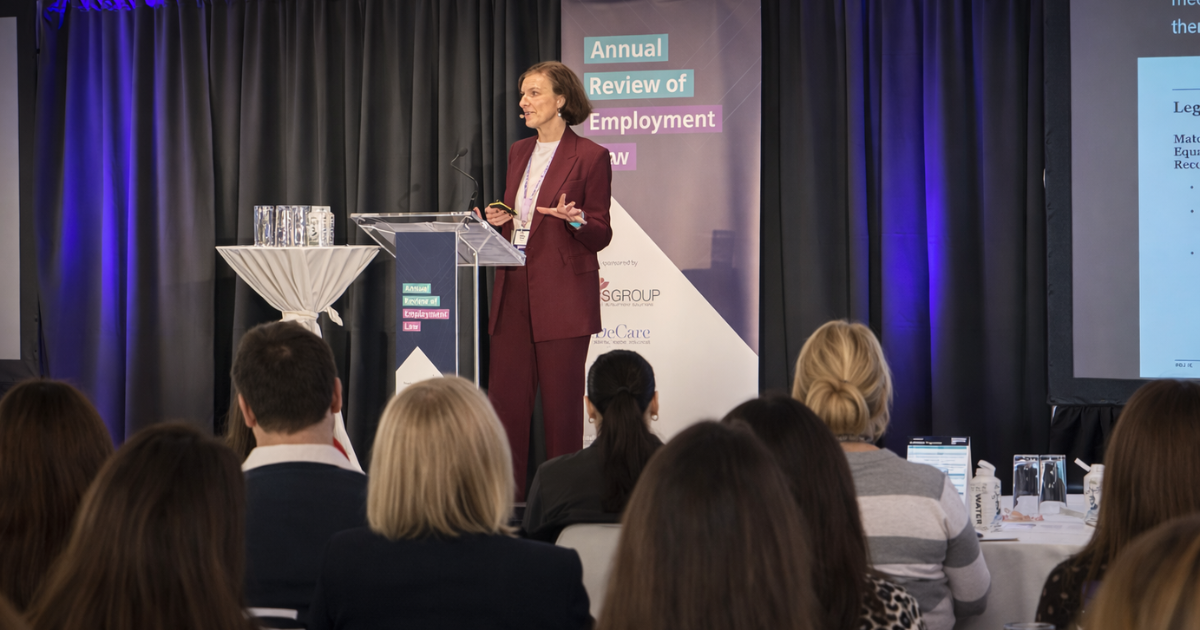

Gerry McMahon is an acknowledged national expert in People Management. He has over 35 years’ experience - as a workplace investigator (on bullying/harassment/ disciplinary/dismissal/grievance issues), trainer, negotiator, facilitator, mediator, arbitrator and team builder - across a wide range of employment sectors. He is the M.D. of the H.R. training and advisory company Productive Personnel Ltd.
Gerry has also had an extensive range of books and articles published and been a columnist with the Industrial Relations News, Irish Times, Sunday Business Post, and Irish Independent and expert commentator on H.R./Employee Relations for R.T.E. and TV3/Virgin. He has also served on numerous Legal Island and C.I.P.D. judging panels and is a Council member of the Irish Association for Industrial Relations.
Contact: Tel. 087-2471415; E-Mail: ppl1gerry@gmail.com
Employers frequently avail of ‘waiver’, ‘compromise’, ‘severance’ or ‘settlement’ agreements to bring employment relationships to a close. It is often the case that in the event of redundancies, the employer will pay an additional sum over and above statutory redundancy to enable a ‘clean exit’. That is, in return for this payment, employers secure a signed off ‘Compromise Agreement’, whereby employees agree that they will make no complaint against the employer in return for this plus payment or ‘consideration’.
However, the legal status of such ‘waiver’, ‘compromise’, ‘severance’ or ‘settlement’ agreements continues to concern workplace practitioners. That is, given the periodic necessity to shed staff or to ‘release’ an employee – whilst avoiding the prospect of an unfair dismissal claim - such agreements are common at work. But it is also common for redundant or released employees to try to renege on the relevant provisions. Hence, case law in this important area is instructive, as it continues to confirm the key constituents of an effective agreement.
List The Acts
A number of Irish employment law statutes (incl. the Unfair Dismissals, Payment of Wages and Protection of Employees (Part-Time Work) Acts) provide that a provision in a ‘compromise agreement’ that tries to exclude or limit the application of, or is inconsistent with any provision of the relevant statute, is void. So, it’s understandable that the status of such agreements is strictly assessed when they surface before third parties. Notably however, despite such a statutory provision, the superior courts have held that waiver agreements are enforceable should certain criteria be met.
The first case of real consequence in this area is Hurley v Royal Yacht Club [1997] ELR 225, where the Circuit Court considered a waiver clause in a compromise agreement in the context of the Unfair Dismissals Acts. The Court applied 2 tests to their assessment:
- that the claimant be advised of their legal entitlements and that the agreement list the enactments covered therein and
- the employee be advised in writing that he/she should take appropriate (legal) advice.
In this instance, the Employment Appeals Tribunal upheld the claim as the ‘advice’ tests were failed, whilst (on appeal) the Circuit Court concurred, adding that:
‘… the applicant was entitled to be advised of his entitlements under the employment protection legislation and that any agreement or compromise should have listed the various Acts which were applicable, or at least made it clear that they had been taken into account by the employee. I am also satisfied that the applicant should have been advised in writing that he should take appropriate advice as to his rights, which presumably in this case, would have been legal advice. In the absence of such advice, I find the agreement to be void.’
The absence of advice also proved fatal in the subsequent Fitzgerald v Pat the Baker (1999) E.L.R. 227 case, when the Tribunal ruled against the respondent employer. In its conclusion, the Tribunal pointed out that the relevant document (or agreement) was ‘prepared by one side without any meaningful negotiation before it was written and the claimant received no advice before he appended his signature’.
The next consequential case - Sunday Newspapers Ltd v Kinsella and Bradley (2008) 19 E.L.R. 53 - was described by the Workplace Relations Commission (WRC) as ‘the leading authority in relation to agreements which compromise employment statutory rights.' Therein, finding against the claimants, the Rights Commissioner held that – whilst benefiting from union representation – they had accepted a severance package and signed a waiver that confirmed their acceptance of the terms in full and final settlement. Notably, this finding was successfully appealed to the Labour Court before the High Court restored the original verdict, pointing out that in the absence of appropriate advice, any such agreement which waives one’s statutory rights would be void.
With regard to whether any such agreement requires the specification of all relevant enactments or whether reference to ‘all or any employment legislation’ overrides this necessity, the subsequent Kasztelan v Fingal County Council (DEC-E2011-189) case is instructive, as the Equality Officer found that: ‘given the number of pieces of employment legislation’ it was reasonable for them to be covered in an appropriate ‘catch all’ reference.
Informed Consent
Returning to the ‘appropriate advice’ precondition featuring in the aforementioned cases, the subsequent hearing of Kerrigan v Smurfit Kappa UD1921/2011 is notable, as the claimant was awarded €10,000 by the Tribunal, despite the fact that he had already accepted over €25k. in full and final settlement of all claims. In this instance, the Tribunal held that the claimant had not been advised to seek legal advice before signing the waiver, whilst emphasising that there must be ‘informed consent’ to secure a waiver’s legal status. Significantly, this ‘informed consent’ criterion subsequently surfaced in the High Court’s endorsement of an employee’s case (and a Labour Court decision thereon) in the Board of Management of Malahide Community School v Conaty [2019] IEHC 486. The Court’s decision served to remind parties that:
‘…The principle of ‘informed consent’ ... A person can only be said to have waived a statutory right if they do so on an informed basis ... A bald statement in the contract to the effect that the Unfair Dismissals Act does not apply ... would not be sufficient ...’.
Significantly though, in this case the High Court gave the ‘all clear’ to such agreements. It acknowledged that if one strictly applied section 13 of the same Act - that tries to exclude or curtail waivers - then any such waiver would be rendered ineffective. However, this would impact on the ability of the parties to compromise unfair dismissal claims, and they would then have to pursue legal proceedings to their conclusion rather than obviate any such costly process via a settlement or compromise.
What’s Estoppel?
Related thereto, in Irish Life Assurance v Healy EDA 1514 (2016) 27 E.L.R. 211, the Labour Court held that the principle of ‘promissory estoppel’ applied. This enables a court to prevent (or estop) a person from going back on his or her word. In this case, the Equality Tribunal had already decided that ‘the stable door had been firmly bolted before the horse left’, as the employee had taken legal advice and subsequently signed the settlement agreement. Hence, the fact that he had changed his mind was inadequate grounds for setting aside the agreement. In effect, this case also serves to confirm that when appropriate steps are taken, a validly executed compromise agreement will be upheld. In this context it is notable that the complainant received a sum in consideration of the settlement, together with a contribution towards his legal costs.
However, given the pressure to proceed with haste in such scenarios, it is also salutary to note the fall-out where a claimant can show that they signed under duress. For example, in Shortt v Data Packaging Limited (1996) ELR 7, the claimant pointed out that the employer’s representative had suggested to him that he wouldn’t get a redundancy payment unless he signed the document. Hence, the Tribunal held in his favour, finding that this act of duress had essentially deprived the claimant of the exercise of free will. Likewise, in 2024, the WRC held that a claimant could pursue his age discrimination and victimisation claim, as the waiver in the settlement agreement was invalid due to the absence of ‘informed consent’. In this instance, the claimant signed the settlement agreement at a meeting that lasted ~10 minutes. He hadn’t seen the agreement in advance, didn’t understand the terms thereof, hadn’t been advised thereon and was suffering chronic anxiety at the time (ADJ-00048678).
Recent Cases
The precedents featuring in these cases have proven influential on subsequent judgements. For example, just last year, in a case involving Accenture Consulting, the Labour Court endorsed a WRC decision, confirming that one may waive their statutory rights if done so on an informed basis, with free will, adequate time to consider the agreement and further to taking legal advice. In this instance, the Court found that Accenture had: (i) made adequate efforts to ensure that the complainant could give informed consent, (ii) advised her to take legal advice, (iii) given her time to do so, (iv) contributed toward the cost of the advice and (v) provided ‘consideration’ (i.e. payment) (UDD2532).
Likewise, just last year, in 2 separate rulings, involving the Citizens Information Service and (telecommunications and internet service provider) Three Ireland, the WRC warned that employees must abide by the terms of severance agreements, where they have received consideration and provided ‘informed consent’ (ADJ-00049012 and ADJ-00052685). These decisions accord with the 2022 Ladbrooks case, where the High Court held it to be imperative that employers advise and extend the opportunity to any employee signing a waiver agreement to seek legal advice (Hennessy v Ladbrooks, IEHC 60 2022).
Somewhat similarly, in another case last year (involving the Ulster Bank), the WRC found that the claimant had not been advised to seek legal advice before signing the compromise agreement. However, as the actual (signed) agreement stated that the claimant had been given the opportunity to take legal advice in advance of signing the agreement, it held in the respondent’s favour (ADJ-00052192). Likewise, in 2023, a former manager at Xerox claimed unfairly dismissal by reason of not having given ‘informed consent’ in respect of the package on offer. However, the WRC held that he only became unhappy with the deal once he struggled to find work elsewhere, whilst there was no evidence that he signed-off under duress (ADJ-00044485). However, in contrast, in 2020, the Labour Court (in Haskiya v Keelings Retail – UDD2023) upheld an unfair dismissal claim, whilst setting aside a WRC decision. In this case the Court held that the relevant settlement agreement was void, on the basis that the employee was not given adequate opportunity to seek independent legal advice prior to waiving his statutory rights.
In a separate case in 2019, the claimant signed a compromise agreement in ‘full and final settlement .. of any and all claims’. However, the claimant subsequently alleged that he was pressurised into signing the agreement and his legal representative ‘did not have knowledge of the Irish legal system’. However, the WRC found that there was ‘informed consent’, as ‘the Complainant was advised in writing to seek legal advice as to his rights and acknowledged that he had availed of such advice by signing the agreement’. Furthermore, the WRC wasn’t furnished with any evidence of pressure being brought to bear that could be deemed to be ‘duress’. Accordingly, it concluded that the complainant was estopped from pursuing a complaint under the relevant Acts (ADJ-00020068).
Shortly thereafter, the Commission declined jurisdiction to hear a case of gender discrimination against Tesco Ireland, where the claimant had already accepted a severance settlement. Subsequent to signing the settlement, the claimant discovered that the severance packages given to others were superior to hers, thus constituting gender discrimination. The respondent (successfully) argued that the WRC did not have jurisdiction to hear her claim, as the claimant had signed a ‘without prejudice’ waiver in full and final settlement of all or any claims. In this instance, the WRC noted that the claimant had adequate time (i.e. 2 months) to consider the terms of the settlement and had even sought a number of clarifications thereon. Notably, she was advised by her union, thus giving rise to an important precedent, as the WRC rejected her argument that advice from a union was not ‘appropriate advice’, pointing out that such advice doesn’t have to be given by a lawyer (ADJ-00021296).
Confidential Or Not?
It is also important to note that the construct of such agreements has been somewhat constrained by the Maternity Protection, Employment Equality and Preservation of Certain Records Act 2024. Arising therefrom, any Non-Disclosure Agreement (NDA) or confidentiality clause in a settlement/severance agreement is automatically deemed void should it try to stop an employee from disclosing:
- An allegation of discrimination, harassment or victimisation,
- Any action taken by the employer or employee further to any such an allegation.
Of course, an NDA clause can be used in the absence of any such allegation and there are some circumstances where they will be deemed permissible, valid and enforceable (e.g. as a component of a WRC mediation agreement; if inserted at the employee’s request further to written legal advice). This Act also provides that the employer shall pay reasonable legal fees incurred by the employee in getting such (written) legal advice. However, it is also noteworthy that an employee can withdraw from the agreement (without penalty) within 14 days of sign off.
Conclusion
The lessons to be learned from this array of judgements are that for a ‘waiver’, ‘compromise’ or ‘settlement’ agreement to withstand scrutiny and be deemed ‘fit for purpose’, it should:
- ensure that the employee has been advised of their legal entitlements and that any compromise agreement lists the enactments applicable thereto. Some such agreements rely solely on a ‘catch all’ phrase. However, ‘to be sure, to be sure’, it would seem judicious to avail of both the listing and ‘catch all’ approaches.
- ensure that the employee is advised in writing that he/she should take appropriate (legal) advice;
- ensure that the employee receives a sum in consideration of the settlement;
- ensure that the employee has adequate time to consider the content of the relevant agreement and can engage in meaningful discussion and negotiation in respect of same;
- and – yet again - ‘to be sure to be sure’, offer the employee a contribution toward their legal costs for the procurement of appropriate legal advice.
However, as is evident from the 2024 ‘Cafico’ case (see ADJ-00050330), it is important for employers to be aware that there are risks to any allegedly ‘without prejudice’ offers designed to bring an employment relationship to an end. That is, ‘protected conversations’ can be introduced as evidence before a third party and may indicate that a subsequent dismissal was predetermined. So, if the employer initiates the (rejected) proposal, it may well shroud any future termination process involving that employee. In the aforementioned case, the WRC viewed the severance offer as the defining moment when the employment relationship was ‘unequivocally and unambiguously damaged’ by the employer, going to its ‘root’ in a manner that ‘utterly undermines the implied term of trust and confidence’.
Dr. Gerry McMahon is a former lecturer at TUD and Adjudicator at the WRC. He is the MD at Productive Personnel Ltd., specialising in H.R./Employee Relations consultancy and training assignments. E-Mail: ppl1gerry@gmail.com
Continue reading
We help hundreds of people like you understand how the latest changes in employment law impact your business.
Please log in to view the full article.
What you'll get:
- Help understand the ramifications of each important case from NI, GB and Europe
- Ensure your organisation's policies and procedures are fully compliant with NI law
- 24/7 access to all the content in the Legal Island Vault for research case law and HR issues
- Receive free preliminary advice on workplace issues from the employment team
Already a subscriber? Log in now or start a free trial

FREE WEBINAR: Employee Data - What ROI & NI Employers Must Collect, Keep, and Delete
Conducting Workplace Investigations and Alternative Conflict Resolution Methods