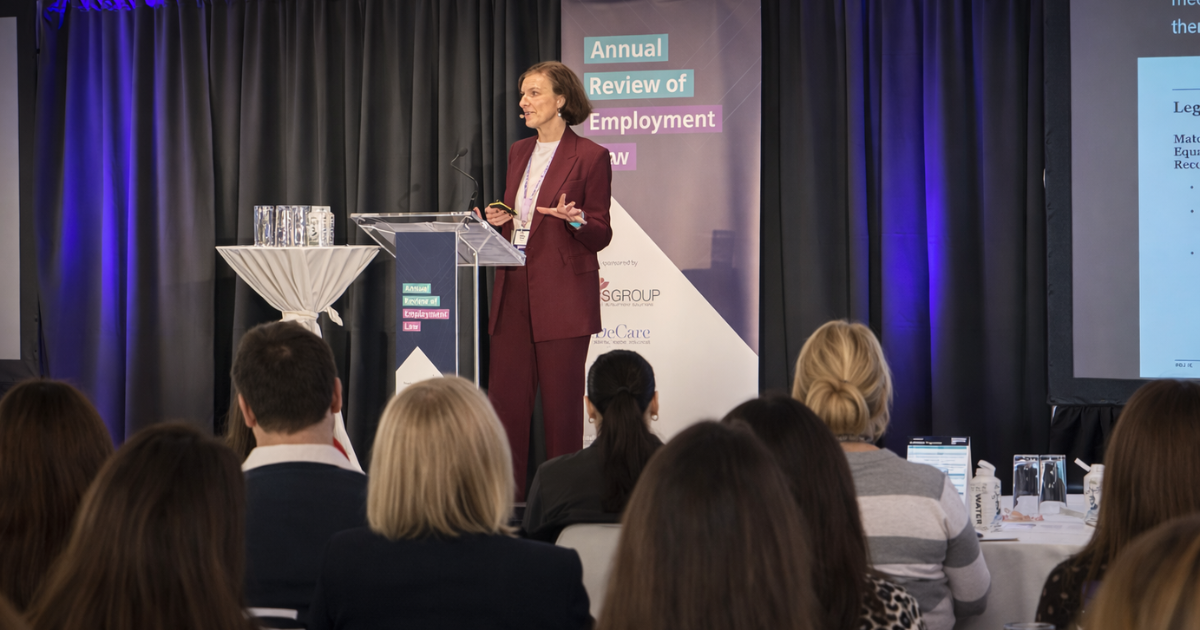

Kate is a Legal Director and is a senior member of the AG employment law team and part of the wider Disputes Group. Kate has extensive experience advising employers on all aspects of the employment relationship. This includes both non-contentious and contentious matters.
Kate predominantly advises commercial clients, mainly international organisations, on a full range of employment law issues including workplace investigations, capability issues, unfair dismissal, discrimination, TUPE, senior executive exits, business reorganisation involving redundancy and collective redundancy processes.
Kate has a particular interest in workplace investigations and specifically in advising clients on complex workplace investigations including investigations involving protected disclosures. Kate regularly speaks on employment law topics at firm events and external training events.
Kate is currently advising clients on a number of complex cases involving capability and reasonable accommodation issues.
We are regularly asked to advise clients in managing situations where employees are struggling during their probationary period. Recently we have seen an increase in cases being brought by employees who are dismissed during the probationary period.
Often these dismissals are when an employee is not considered a ‘good fit’ for the role and no process is invoked by the employer. While it is generally established that probationary periods can be used as a trial period it is important for employers to be aware that dismissal during a probationary period is not risk free.
In this article Kate Field of AG advises on drafting and reviewing probationary clauses and importantly looks at the recent case law on dismissing employees during probationary periods.
Probationary clause in contracts
Employers should ensure that all contracts of employment have a clear probationary clause that complies with the Transparent and Predictable Working Conditions Regulations 2022 (“2022 Regulations”) which came into effect in December 2022. Under the 2022 Regulations probationary periods for private sector employees cannot exceed six months. The 2022 Regulations provide that, the probationary period may, on an exceptional basis, be longer than six months provided the period does not exceed 12 months and the longer period is in the interest of the employee. The 2022 Regulations also provide that where an employee is absent during the probationary period it can be extended by the employer for the duration of the absence.
Therefore, the probationary clause should enable an employer to extend the period up to 12 months if exceptional circumstances arise and where a longer period is in the best interest of an employee. For example, a longer period could be in the best interests of the employee if it is to provide the employee with further support or training to reach the required standards expected for the role. In addition to including the right to have a longer probationary clause in the contract the employer should ensure that any extension required is documented in writing and the reasons provided to the employee. When extending probationary periods employers should always be mindful that notice periods count as part of service so these need to be taken into account in any extension.
Potential claims if dismissed during probation
Generally, an employee cannot bring a claim for unfair dismissal unless they have 12 months or 52 weeks continuous service. However, employees who do not have 12 months service can bring a claim to the Workplace Relations Commission (WRC) under section 20(1) of the Industrial Relations Act, 1969. Under this Act this WRC can only issue a non-binding recommendation. Despite being non-binding these cases can cause reputational damage for employers.
An employee with less than 12 months service can also bring a claim for unfair dismissal if they believe their dismissal was discriminatory and based on any of the nine grounds in the Employment Equality Acts, 1998-2015. Importantly there is an exception to the service requirement under the Unfair Dismissals Acts, 1977-20 15 if the employee is dismissed in relation to their pregnancy or maternity leave or for taking statutory leave or for trade union membership or as we are seeing more often for raising a protected disclosure.
An employee can also bring a claim for wrongful dismissal during probation for breach of contract and a bring claim for injunctive relief restraining the dismissal.
Fair procedures during probationary periods
While it is standard practice for a probationary clause to provide that the full disciplinary procedures do not apply during a probationary period employers should be aware that the Labour Court has long held that employees are entitled to fairness during their probationary period. In particular where a dismissal relates to misconduct as opposed to poor performance an employee on probation should be entitled to fair procedures as the requirements set out in the Code of Practice on Grievance and Disciplinary Procedures (SI 146/2000) apply during probation as held by the Labour Court in Glenpatrick Watercoolers Ltd. –v- A Worker [2015] LCR21028.
Recent High Court case law has reiterated that an employee can be dismissed during their probationary period without being provided with full fair procedures if the dismissal is related to poor performance or if there is no reason for the dismissal. However, where the dismissal relates in any way to misconduct an employer must comply with fair procedures. This position was reiterated in the High Court decision of Buttimer v Oak Fuel Supermarket Limited Trading as Costcutter Rathcormac [2023] EHC 126. In this case the employee was employed as a supervisor with the understanding she would soon after be appointed as a manager. A few weeks after commencing employment, bullying and harassment allegations were made against the employee and an investigation was commenced by an independent HR consultant on behalf of the employer. Despite the investigation commencing the employee was promoted to the role of store manager and a new contract of employment provided to her. Shortly after promoting her the manager received further complaints and called her into a meeting and dismissed her for failing to pass her probation. The probationary clause in her contract allowed for the employee to be dismissed without cause during the six-month probationary period and stated that the disciplinary process did not apply during the probationary period.
The employee alleged that she was dismissed as a direct result of the allegations of misconduct made against her which were being investigated and her dismissal was unfair as she was afforded no fair procedures. The employee applied to the High Court for an injunction restraining her dismissal and the appointment of a new employee in the role of store manager. The employer argued that the employee was dismissed fairly during her probationary period because she was ‘not a good fit’ and her dismissal related to performance rather than misconduct. The employer relied on the Court of Appeal decision in O'Donovan v Over-C Technology Ltd & Anor [2021] IECA 37 where the Court of Appeal held that where an employer has a right during a probationary period to dismiss an employee on notice without giving any reason a Court cannot imply a term into the contract that fair procedures be afforded unless an employee is dismissed for misconduct in which case the principles of natural justice apply and fair procedures must be followed.
In the Buttimer case the proceedings related to an application for an injunction and to succeed the employee needed to establish that they had a strong case and were likely to succeed at the hearing of the main case. At this injunction stage the High Court concluded that the employee had established that her employment was terminated due to the allegations of misconduct made against her rather than poor performance. Importantly the High Court held that the fact that some behaviour could amount to both misconduct and poor performance does not prevent the behaviour from being misconduct.
Key steps for employers
It is clear from the High Court case law that employers are required to deal with employees at risk of dismissal during probation due to misconduct differently to those struggling with performance issues. Despite the High Court case law that employees who are not performing on probation are not entitled to full fair procedures there are many Labour Court decisions which held that employees on probation are entitled at a bare minimum to be informed of any issues with their performance and are at risk of dismissal. The employees must also be given an opportunity to reach these required standards through support and training before any decision is made to terminate employment during probation. Importantly employers should look at probation as an on-going process and if performance issues arise during probation the employee should be notified promptly of these issues and provided with support through shadowing/meetings and training. It is also important to document these issues in writing and make sure the employee is aware that if their performance does not meet the required standards during probation they may be at risk of dismissal.
This article was written by Kate Field, Legal Director, Addleshaw Goddard (Ireland) LLP.
Tel: +353 1 202 6550
https://www.addleshawgoddard.com/en/
Continue reading
We help hundreds of people like you understand how the latest changes in employment law impact your business.
Please log in to view the full article.
What you'll get:
- Help understand the ramifications of each important case from NI, GB and Europe
- Ensure your organisation's policies and procedures are fully compliant with NI law
- 24/7 access to all the content in the Legal Island Vault for research case law and HR issues
- Receive free preliminary advice on workplace issues from the employment team
Already a subscriber? Log in now or start a free trial