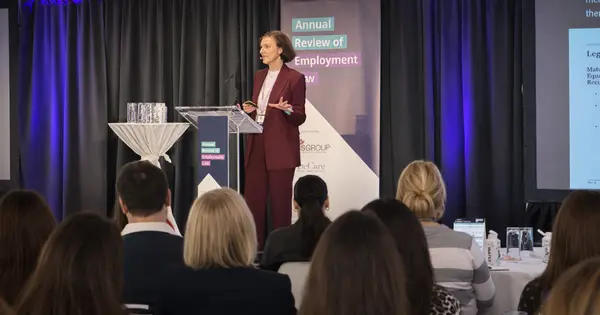

Duncan Inverarity is a former a partner and Head of A&L Goodbody's Employment Law group and practiced exclusively in the area of employment law and industrial relations in multiple jurisdictions. Duncan advised public and private sector employers on both contentious and non-contentious matters. He advised Board rooms across Ireland and abroad on strategic and complex employment and industrial relations matters. Duncan also specialised in crisis management for clients and advised on some of the most high profile corporate issues in Ireland. Duncan regularly appeared for clients in the Workplace Relations Commission, the Circuit Court, the High Court, the Court of Appeal and the Supreme Court. Duncan also acted for partnerships in mediated settlements and in proceedings in the High Court.
The High Court revived key European Works Council rights, ruling Verizon disputes over expert funding and collective complaints were wrongly narrowed under Irish law implementing the EU Directive.
The case arose from disputes concerning the operation of a European Work Council (EWC) for Verizon Communications Inc, which operates under the Transnational Information and Consultation of Employees Act 1996 (TICEA) implementing Directive 2009/38/EC (the Directive). Two Labour Court determinations were appealed on points of law.
- an invoice dispute (TID241) concerning whether central management must fund expert assistance obtained by the EWC Select Committee from the EWC Academy;
- a training dispute (TID242) concerning whether Verizon was obliged to fund Mr. Charpentier’s attendance at external training in Hamburg in September 2021 notwithstanding that management had provided training in May 2021;
- and whether any costs could be awarded / reimbursed in connection with the proceedings.
The Labour Court rejected Mr. Charpentier’s claim under Section 17 of TICEA, declined to order payment of the expert invoice and treated the costs issue as moot because the appeals from the WRC failed.
What did the High Court decide?
The High Court partly upheld and partly set aside the Labour Court’s determinations. The High Court found:
- In relation to Mr Charpentier’s argument regarding the adequacy of the May 2021 training and the refusal to fund the Hamburg attendance, these were held to be findings of fact within the Labour Court’s remit. On a point of law appeal, Mr. Charpentier did not discharge the burden to disturb those findings. Accordingly, the Labour Court’s conclusions on the sufficiency of the May training and the reasonableness of refusing the Hamburg funding stood;
- The Labour Court erred in law by interpreting Section 17 as limited to individual rights and excluding collective disputes. TICEA must be construed so far as possible in conformity with the Directive;
- The Labour Court fell into an error of law in failing to examine the Appellant’s complaint that the EWC Academy’s advices were necessary and appropriate as expert costs properly incurred by the EWC for the purpose of applying the rights arising from the Directive;
- The Labour Court fell into an error of law in failing to consider Mr. Charpentier’s application for costs, simply because the appeals had not been upheld.
The impugned parts of both Labour Court determinations were set aside on the identified errors of law. The High Court will hear Counsel on precise orders on 3 December 2025.
Key takeaways
- Irish Courts, the WRC and the Labour Court must interpret TICEA in line with the Directive;
- Section 17 of TICEA is not limited to individual claims;
- Collective complaints and enforcement of obligations related to EWC operation can fall within Section 17;
- Even where the Labour Court lacks a free-standing costs jurisdiction, it must consider whether legal/expert expenses must be reimbursed;
- Criminal sanctions alone do not satisfy the Directive;
- Adequate administrative / judicial procedures must be available in practice and decision makers must provide sufficient reasons and engage with EU law arguments.
The full case can be found here.
As of the date of this case review, this case is currently on appeal to the Supreme Court.
Continue reading
We help hundreds of people like you understand how the latest changes in employment law impact your business.
Please log in to view the full article.
What you'll get:
- Help understand the ramifications of each important case from NI, GB and Europe
- Ensure your organisation's policies and procedures are fully compliant with NI law
- 24/7 access to all the content in the Legal Island Vault for research case law and HR issues
- Receive free preliminary advice on workplace issues from the employment team
Already a subscriber? Log in now or start a free trial

FREE WEBINAR: Employee Data - What ROI & NI Employers Must Collect, Keep, and Delete