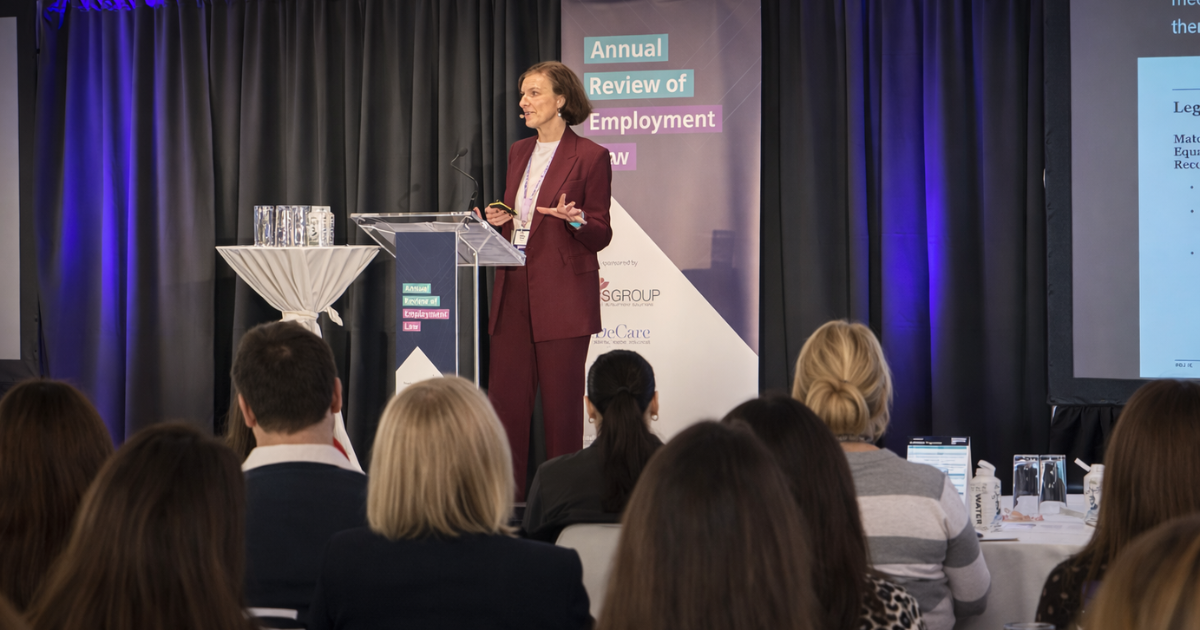

Kate is a Partner in the AG employment law team and part of the wider Disputes Group. Kate has extensive experience advising employers on all aspects of the employment relationship. This includes both non-contentious and contentious matters.
Kate predominantly advises commercial clients, mainly international organisations, on a full range of employment law issues including workplace investigations, capability issues, unfair dismissal, discrimination, TUPE, senior executive exits, business reorganisation involving redundancy and collective redundancy processes.
Kate has a particular interest in workplace investigations and specifically in advising clients on complex workplace investigations including investigations involving protected disclosures. Kate regularly speaks on employment law topics at firm events and external training events.
Kate is currently advising clients on a number of complex cases involving capability and reasonable accommodation issues.
The 7 June 2026 deadline for full transposition of EU Directive 2023/970 into Irish law has been and gone and the Minister for Children, Disability and Equality (Minister) has now confirmed that Ireland will implement the Directive on a phased approach. Due to Ireland’s delay in implementation the Minister also confirmed that employers will not be penalised for failing to comply with the requirements of the Directive that have not yet been introduced into Irish law.
In this article Kate Field of AG responds to frequently asked questions raised recently by clients in preparation for the 7 June deadline.
As the deadline to implement the Directive has passed does this mean that employers in Ireland can relax?
The delay in implementation means that employers have more time to prepare. Employers need to be very clear that the Directive will shortly be an important part of Irish employment law. Employers should be reminded that parts of the Directive have already been implemented through the Gender Pay Gap Information Act, 2021 (2021 Act) which introduced gender pay gap reporting on a phased basis and now applies to all organisations that employ over 50 employees. The Minister recently confirmed that it is intended that the Gender Pay Gap Reporting portal will be operational from November 2026 and all employers will be expected to upload their gender pay gap data from the ‘snapshot’ date in June 2026 to the centralised portal (subject to an amendment to the 2021 Act being introduced). Currently uploading to the portal is voluntary only.
The Minister also confirmed that work is ongoing to transpose the remaining provisions of the Directive. A dedicated Irish employer gender-neutral job evaluation toolkit based on the European Commission’s toolkit is being drafted by the Department. Once the legislation and guidance is published, it is expected that workshops will be set up for employers to assist employers understand the toolkit and their new obligations under the Directive particularly in relation to job evaluation.
What does the Directive mean for hiring new people?
Recruitment is an area where substantial change will be introduced as a result of the Directive. Employers must tell job applicants about the starting pay or pay range for the job, and this has to be based on clear, objective criteria. An employer will not be able to ask a candidate about their current or past salary anymore. Also, job adverts, titles, and the recruitment process itself must be gender-neutral and non-discriminatory. The idea is to make pay fair from the start of the process and avoid carrying forward any old inequalities.
The Directive does not prohibit asking about salary expectations. That said, salary expectation discussions must not be used as an indirect way of anchoring compensation to previous pay levels. The overarching principle remains that compensation must be based on objective, gender-neutral criteria and predefined salary structures. From a compliance perspective, it is advisable to ensure that any discussion of expectations takes place within a clearly defined and pre-established salary band for the role.
What do employers need to know about pay structures and how pay is set internally?
Employers will need to define salary bands for each role and stick to them when making pay decisions. The Directive requires employers to ensure equal pay for equal or equivalent work through pay structures, and to justify and document any differences. In practice, this means using objective and gender-neutral criteria agreed with employee representatives where they exist. These criteria should cover things like skills, effort, responsibility, and working conditions, and any other relevant factors for the role.
It is important to be aware that defining categories of employees will also involve an assessment of whether employees are carrying out work of equal value. The Directive obliges member states to make tools or methodologies available to employers to assist in conducting an assessment of work of equal value. We know from existing case law that many factors will be considered in determining whether two jobs are of “equal value”, including skill, physical and mental requirements, level of autonomy, responsibility and working conditions. In Ireland the IHREC Code of Practice on Equal Pay, published in 2022, also provides useful guidance for employers.
Is ‘pay’ defined under the Directive?
‘Pay’ is defined broadly and it includes not only monetary salary but also variable pays and benefits paid directly or indirectly by the employer, such as bonuses, allowances, company cars, equity-based incentives or pension contributions.
What about discretionary bonuses. Will these be a thing of the past going forward?
Discretionary bonuses are not prohibited under the Directive, but they carry a higher legal risk because they are often based on unclear or undocumented criteria. Where discretionary elements are applied inconsistently or without transparent evaluation criteria, it becomes more difficult for employers to justify that pay differences. This does not mean discretionary schemes must be removed. It just means that employers should set clear evaluation criteria, document decisions, and use them consistently across comparable roles.
Does the Directive apply to employees and exclude contractors or apply to both?
The Directive applies to "workers" who have an employment contract or employment relationship, as defined by the law, collective agreements, or practice in each Member State. This typically includes payroll employees, part-time workers, fixed-term workers, agency workers, and others who are considered employees under national law. It does not apply to contractors or self-employed persons who do not have an employment contract or employment relationship. In principle, only those who are legally recognised as employees are covered by the Directive.
What can employers do now to prepare?
It’s really important to start preparations now. A good idea would be to start looking at the workforce and perhaps look at conducting an equal pay audit.
In preparation employers could do the following:
- Create an inventory of roles: List every role in the organisation.
- Apply objective, gender-neutral criteria to the roles to categorise them: Criteria such as skills, responsibility, education.
- Group by "value" not "title": Certain roles might have different titles, but if their skill requirement, autonomy, and effort are deemed comparable, they could fall into the same category of "equal value"
- Audit: Conduct a dry run equal pay gap to identify any discrepancies across categories of employees carrying out the same or equivalent work.
An equal pay audit can help an employer spot any issues before they become claims. But employers must be aware that if they find a problem, they will need to address it.
What’s the difference between equal pay audits and gender pay gap reporting?
Equal pay audits look for specific instances where people doing the same or similar work are paid differently without a good reason. Gender pay gap reporting, which is already in place, is more about the overall difference in average pay between men and women in the organisation. A gap doesn’t always mean there’s a legal problem, but it can highlight areas to investigate.
Once the Directive is implemented, if an organisation has a gap of 5% or more in any category of workers and can’t explain it with objective, gender-neutral factors, it will need to carry out a joint pay assessment. This means a deeper dive into the pay practices, working with employee representatives, and taking action to fix any unjustified gaps. It’s best for employers to be proactive - review pay structures, get data in order, and start making changes now.
Is an employee entitled to request specific information in relation to their ‘pay’?
Under the Directive employees will have the right to receive information regarding pay levels and the pay levels of colleagues performing the same or similar work. Employers with over 50 workers will be required to make accessible to employees the criteria they use to determine workers’ pay, pay levels and pay progression.
Employees will have the right to request and receive information in writing about:
- Their individual pay level
- The average pay levels for workers in similar roles
The average pay levels must be broken down by gender and apply to:
- Employees performing the same work
- Employees performing work of equal value
This information must be provided within two months of the request being made.
When complying with these requests, employers will need to be mindful of balancing pay transparency rights with data protection/privacy rights. When sharing information employers should use techniques such as anonymisation and secure data sharing platforms as employers must still comply with data protection rules and legislation implementing GDPR.
What about enforcement and legal risks?
The Directive gives employees stronger rights to bring claims. In Ireland the claims that are likely to be brought will be a claim for discrimination under the Employment Equality Acts. An employee can bring an equal pay claim to the WRC or an equality claim based on the gender ground to the Circuit Court. There is no time limit for equal pay claims under equality legislation, so the general limitation period under the Statute of Limitation on breach of contract applies. This means that currently an employee must make a claim within 6 years of the disparity in pay. The Directive provides that the statute of limitations does not begin to run before the employee knows or could reasonably have been expected to know about the infringement.
Currently in discrimination cases the WRC can award compensation of up to two years remuneration or €40,000 whichever is the greatest. The Circuit Court can order that an employee receives equal pay plus up to 6 years pay arrears. Significantly, Directive provides that compensation in equal pay claims includes all back pay including bonuses, payments in kind, compensation for lost opportunities and interest on arrears, with no limit on compensation.
Under the Directive the employer will now be required to prove that there has been no direct or indirect discrimination regarding pay. The Directive also removes the requirement for a real-life comparator where one is not available in equal pay claims.
The overall advice to employers is to start preparations now if you haven’t started already. Review policies, pay structures, recruitment processes, and data systems now.