

Barry Phillips (CEO) BEM founded Legal Island in 1998. He is a qualified barrister, trainer, coach, and meditator, and a regular speaker here in the UK and Ireland, and abroad.
Barry has completed the Oxford University course “Leading AI Implementation” in June 2026. He has trained hundreds of HR Professionals on how to use GenAI in the workplace and is the author of the book “ChatGPT in HR – A Practical Guide for Employers and HR Professionals”


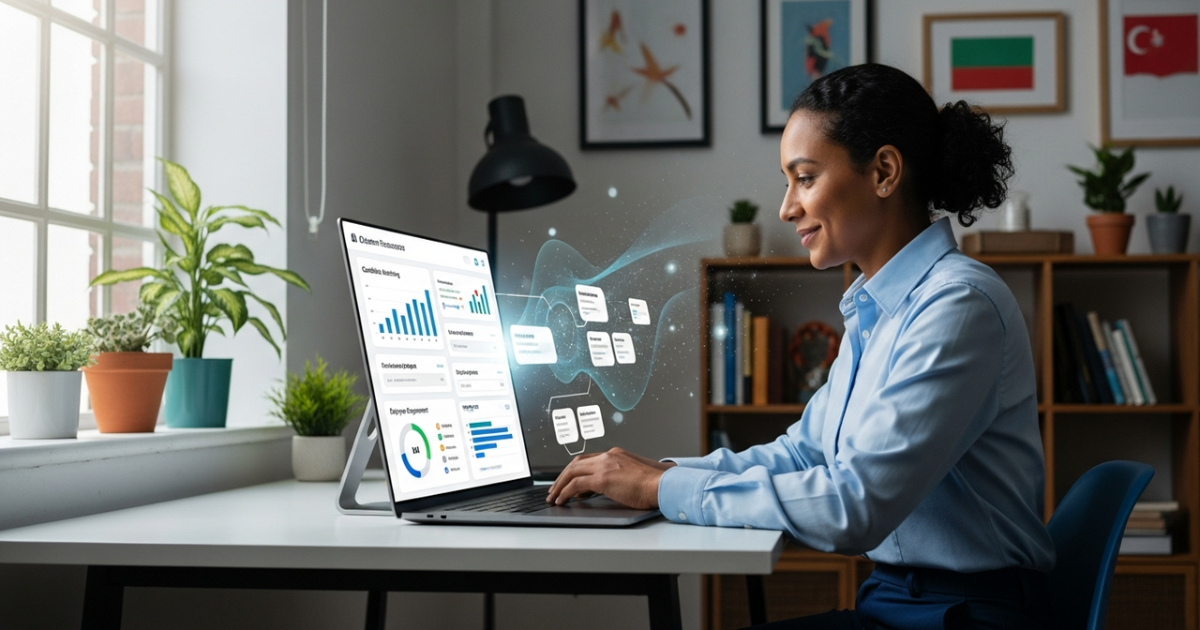
This week, Barry Phillips asks whether AI has finally delivered a huge time saver few organisations and employees seem to be using.
Transcript:
Hello Humans!
And welcome to the weekly podcast that aims to address in five minutes or less an important AI development relevant to the world of HR. My name is Barry Phillips.
I want to talk to you today about something that sounds almost mundane, but which I think represents one of the most significant productivity opportunities your organisation has right now. I'm talking about dictation. Speaking to your computer and helping employees to finally stop pecking at keyboards like caffeinated pigeons!
And before you say “I’ve tried dictating to my PC and it doesn’t work, hear me out because this time, it actually works.
Let's take a quick step back through history, because I think context matters here.
The way humans interact with computers has gone through just a handful of truly transformative moments. The first was the punch card. Workers physically feeding instructions into machines, one card at a time. Precise, painstaking, and about as far from natural human communication as you can get.
Then came the keyboard and mouse; the combination that has dominated the workplace for over forty years. It democratised computing, but it also created an invisible tax on every worker, every single day: the cost of translating thought into typed text.
After that, touchscreens and with them, the smartphone era. Suddenly, we had a more intuitive relationship with our devices. But we were still, essentially, using our fingers as intermediaries between our minds and our machines.
And now we arrive at the fourth evolution: audio. The human voice. The most natural communication tool we have ever had, finally being understood by the machines we use to work.
Dictation, of course, is not new. In the late 1990s I attended a law society technology fair and tried an early example of voice recognition software. It was, frankly, amusing to play with but unusable. It needed extensive training, stumbled over accents, fell apart in noisy environments, and produced transcripts that required more correction than if you'd simply typed in the first place. The technology made promises it couldn't keep. The people promoting the system said it was being fine-tuned. When I returned the next year, it was still being fine-tuned. The following year I don’t remember seeing any voice technology there at all.
Modern AI-powered dictation, built into tools many of your employees already have access to, now achieves accuracy rates of around 98%. It understands context, adds punctuation intelligently, and adapts to professional vocabulary. The friction that made old dictation unusable has, for most practical purposes, been removed. At Legal Island we’re currently testing Wisprflow.ai. It is pretty damn good.
So what does this mean in numbers your company head will care about?
The average office worker types at roughly 40 words per minute. The average person speaks at around 130 to 150 words per minute. Typing a thousand words takes approximately 25 minutes; dictating the same content takes around 8 minutes. That's a time saving of more than two-thirds on any writing task.
Industry specialists report that switching to voice documentation is saving clients at least one hour per day which compounds to over five hours per week and more than 260 hours per year, per employee.
Now multiply that across your workforce. If you have 200 employees, and even half of them recover just 30 minutes a day through voice dictation; that's 50 hours of productive capacity returned to your organisation every single day. For knowledge workers, one analysis in the US estimated the productivity value of voice dictation at around $18,000 per employee annually in recovered working time. The return on what is often a negligible software investment is, by any measure, extraordinary.
And there is a wellbeing dimension too. Repetitive strain injuries, and chronic back and wrist pain cost organisations millions in sick days and reduced output every year. Reducing keyboard dependency addresses all of those risks simultaneously.
Here is the thought I'd like to leave you with.
Every generation of technology has asked workers to adapt to the machine.
Punch cards demanded precision. Keyboards demanded speed. Touchscreens demanded dexterity. But voice dictation flips that relationship entirely . It asks the machine to adapt to us. To listen to the way we actually think, at the speed we actually think. For the first time in the history of computing, the most natural thing a human being can do, simply speaking, is also the most productive thing they can do at work.
For HR professionals thinking about efficiency, wellbeing, inclusion, and the future of work, this is not a technology trend to monitor. It is a lever to pull; and the time to pull it is now.
Bye for now.