

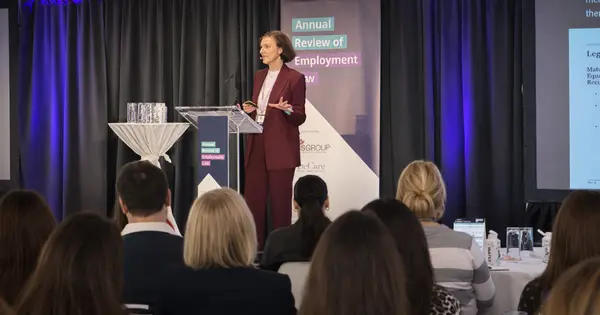
Caroline Reidy is Head of HR Solutions at NFP and a HR and Employment Law Specialist. Caroline sold her company, The HR Suite, in 2025 to NFP, an AON Company, and as of 17th November 2025 The HR Suite officially rebranded to NFP.
Caroline is a former member of the Low Pay Commission and is also an adjudicator in the Workplace Relations Commission. Caroline is also an independent expert observer appointed by the European Parliament to the Board of Eurofound. Caroline is also on the Board of the Design and Craft Council Ireland and is a Governor on the Board of Munster Technology University.
She has also completed a Master's in Human Resources at the University of Limerick, and she is CIPD accredited as well as being a trained mediator. Caroline completed her diploma in Company direction from the IOD with a Distinction and completed her assessment to become a Chartered Director of the IOD. Caroline had worked across various areas of HR for over 25 years in Kerry Group and in the retail and hospitality sector, where she was the Operations and HR Director of the Garvey Group prior to setting up The HR Suite in 2009.
She has also written 2 books, has done a TEDx and is a regular conference speaker and contributor to national media and is recognised as a thought leader in the area of HR and employment law. Caroline also mentored female entrepreneurs on the Acorns Programme. Originally from Ballyheigue, Co. Kerry, now living in Dublin, is very proud of her Kerry roots.
With life expectancy increasing and health outcomes improving, more employees are choosing or needing to work beyond traditional retirement ages. This is reshaping workplace dynamics and creating new challenges for HR professionals. The Employment (Contractual Retirement Ages) Bill 2025 (enacted 16 December 2025), introduces important changes that organisations and particularly HR specialists must understand to remain compliant and strategically prepared.
Underlying factors:
Improved health: people are living longer, healthier lives, making extended careers feasible.
Financial necessity: rising living costs and pension gaps mean many workers feel it is an economic necessity to extend their working life.
Flexible work options: Remote work and part-time arrangements make continued employment attractive.
Older employees bring knowledge and experience, capability around mentoring and training, and stability which are assets that are invaluable to employers, amid Ireland’s ongoing talent shortage. The working-longer trend also supports broader economic growth and helps sustain the pension system.
This Bill’s primary aim is to allow but not compel employees to remain in employment until they reach the State Pension age, currently set at 66. This measure addresses income gaps for those forced to retire at 65 and reduces reliance on Jobseekers Benefit. For employers, however, it introduces new compliance obligations and fundamentally alters the legal framework surrounding retirement particularly for those employers who heretofore have sought to retire staff under the state retirement age, for example at 65.
Key provisions:
Employee notification: Employees can notify their employer 3–12 months before their contractual retirement date that they do not consent to retire at the contractual age, provided that age is below the State Pension age.
Employer response: Employers must issue a written, reasoned reply within one month of receiving such a notification.
Objective Justification: Retirement can only be enforced if it is objectively justified for that individual employee, not based on a general policy.
Dispute resolution: Employees may refer disputes to the Workplace Relations Commission (WRC). Remedies include reinstatement or compensation of up to 104 weeks’ pay or €40,000.
Anti-penalisation: Employers are prohibited from penalising employees who request to work beyond the contractual retirement age.
Interaction with existing equality legislation
The Employment Equality Acts 1998–2021 already provide protections against age discrimination. Employees who believe they were retired unfairly can lodge complaints under these Acts. The new Bill does not replace these rights; rather, it adds an additional layer of protection for employees who refuse to retire before reaching the State Pension age. In other words it gives stronger protection to those employees who may find themselves forcibly retired but with no state pension income for a period of currently one year (important note: if state pension age increases in the future to 67/68, as is likely but not confirmed, this more robust protection will cover an elongated gap for an ever increasing cohort of retired staff, if any employer’s contractual retirement age remains at less that the state pension age.)
Under current equality law, employers must justify mandatory retirement based on a legitimate aim and demonstrate that the means of achieving that aim are appropriate and necessary - typically assessed for a class of employees.
Under the new Bill, justification must relate to the individual employee, making the process more rigorous and employer obligations more onerous.
It is important to note that the introduction of this new legislation does not make the state retirement age (currently 66) a de facto retirement age that can be implemented without challenge across the board. Employees 66 and over can continue to seek legislative relief from enforced retirement by way of a challenge related to age discrimination under the Equality Acts.
Whilst compensation under the new Bill aligns with existing equality legislation, relief cannot be granted under both Acts simultaneously.
Implications for HR:
Retention vs. succession: HR must continue to balance retaining experienced staff with creating opportunities for younger employees.
Contractual updates: Employment contracts, pension schemes, and pension policies in employee handbooks must be reviewed and updated to reflect the new legal requirements.
Legal risk: HR specialists must navigate compliance carefully to avoid costly and complex disputes as the likelihood of WRC cases will increase.
Next steps:
Review contracts: Identify employees with contractual retirement ages below 66.
Update policies: Align contracts, pension schemes, and employee handbooks with the Bill.
Define clear procedures/timelines: For handling notifications and employer responses.
Train Managers: Ensure managers understand compliance requirements, objective justification standards, and anti-penalisation rules.
Plan workforce strategy: Develop strategies to balance retention with career progression for younger staff.
Communicate clearly: Inform employees about their rights and options under the new legislation.
Prepare for WRC cases: Establish documentation standards and defined processes for handling and escalation of any cases.
Explore flexibility: Offer remote work, part-time roles, and/or fixed-term contracts (for example where specific project work exists) to accommodate older workers.
Monitor costs: Assess the financial impact on payroll and succession planning.
Stay updated: Keep a close eye on legislative developments and emerging case law.
Conclusion
The Employment (Contractual Retirement Ages) Bill 2025 represents a significant shift in Ireland’s employment landscape. For HR professionals, the challenge lies in balancing compliance with strategic workforce planning. By updating policies, training managers, and fostering flexibility, organisations can turn this legislative change into an opportunity—retaining valuable experience while supporting fairness and equality in the workplace.
This article was provided by Caroline Reidy, Head of NFP HR Solutions Ireland Limited, HR and Employment Law Specialist.
Email: hrsolutions@nfpireland.ie
Tel: (066)7102887
For more information visit https://nfpireland.ie