

Remote Working in Ireland: What Recent Cases and Practice Are Really Showing
Published on: 19/02/2026
Issues Covered:
Article Authors The main content of this article was provided by the following authors.
Caroline Reidy Head of HR Solutions, NFP
Caroline Reidy new pic

Caroline Reidy is Head of HR Solutions at NFP and a HR and Employment Law Specialist. Caroline sold her company, The HR Suite, in 2025 to NFP, an AON Company, and as of 17th November 2025 The HR Suite officially rebranded to NFP.

Caroline is a former member of the Low Pay Commission and is also an adjudicator in the Workplace Relations Commission. Caroline is also an independent expert observer appointed by the European Parliament to the Board of Eurofound. Caroline is also on the Board of the Design and Craft Council Ireland and is a Governor on the Board of Munster Technology University.   

She has also completed a Master's in Human Resources at the University of Limerick, and she is CIPD accredited as well as being a trained mediator.  Caroline completed her diploma in Company direction from the IOD with a Distinction and completed her assessment to become a Chartered Director of the IOD.  Caroline had worked across various areas of HR for over 25 years in Kerry Group and in the retail and hospitality sector, where she was the Operations and HR Director of the Garvey Group prior to setting up The HR Suite in 2009.

She has also written 2 books, has done a TEDx and is a regular conference speaker and contributor to national media and is recognised as a thought leader in the area of HR and employment law.  Caroline also mentored female entrepreneurs on the Acorns Programme.  Originally from Ballyheigue, Co. Kerry, now living in Dublin, is very proud of her Kerry roots.
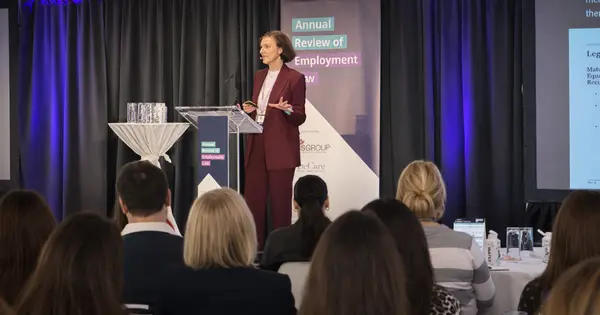
Remote and hybrid working are now firmly embedded in Irish working life. Since the right to request remote working came into effect in March 2024 under the Work Life Balance and Miscellaneous Provisions Act 2023, organisations have been trying to reconcile employee expectations with the practical realities of managing teams, performance and consistency. 

The Government formally launched a public consultation in November 2025 as part of the statutory review required under Section 29 of the Work Life Balance and Miscellaneous Provisions Act 2023 .This consultation invited submissions from employees, employers and other stakeholders on how the legislation is working in practice, whether it is clear and accessible, and whether it has produced any unintended consequences since its introduction. The consultation formed part of the government’s commitment to ensure the legislation remains up to date and reflects real-world experience and is intended to inform recommendations on whether clarifications or changes are needed to support both employees and employers effectively as remote and hybrid work arrangements continue to evolve.

What the legislation requires in practice 

The Act gives eligible employees a statutory right to request a remote working arrangement. Employers must consider the request, having regard to both business needs and the employee’s reasons, and issue a written response within the prescribed timeframe. Importantly, the legislation does not create a presumption that remote working should be approved, nor does it override contractual place-of-work provisions.

One aspect of the Act has been particularly influential in shaping how disputes are resolved. Under  Section 27 of the Act, it limits the WRC’s role to assessing whether the employer complied with the required process. It does not permit an adjudication officer to examine whether the employer’s reasons were reasonable or proportionate, provided the statutory steps were followed. That distinction has proven decisive in the early case law.

What the WRC has said so far 

The clearest guidance to date comes from the recent TikTok decisions, including Zaurbek Musaev v TikTok Technology Ltd and Alina Karabko v TikTok Technology Ltd. In both cases, employees sought to work remotely on a permanent basis and challenged their employer’s refusal.

In Musaev, the employee lived a significant distance from the workplace and relied on personal and medical factors to support his request. TikTok engaged with the request, applied its internal procedures and issued a written refusal. The WRC accepted that the statutory process had been followed and confirmed that it had no remit to assess the substance of the decision itself. The complaint failed.

A similar approach was taken in Karabko, where the WRC again found that the employer had complied with its obligations under the Act and declined to interfere with the refusal once the procedural requirements were met.

What stands out from these decisions is not simply their outcome, the message is consistent, where employers engage properly with requests, document their reasoning and meet the statutory timelines, the WRC will not substitute its judgment for that of the organisation.

Hybrid working beyond the legal framework 

While the legal position is becoming clearer, the operational reality for employers remains complex. Hybrid working continues to present challenges around performance management, collaboration and equity between employees who are regularly present in the workplace and those who are not.

These challenges are often more pronounced in regulated or customer-facing sectors, where employers have increasingly emphasised structured hybrid attendance and office presence, citing governance, supervision and consistency.

By contrast, some employers have chosen to make flexibility a core part of their operating model. Organisations such as Spotify have adopted highly flexible “work from where you work best” approaches, placing greater emphasis on outputs, trust and role design rather than physical presence.

A more structured example can be seen in Phoenix Group, whose “Phoenix Flex” framework was developed following extensive consultation and piloting. Rather than treating hybrid working as an informal arrangement, the organisation assessed customer needs first, then team requirements, before considering individual preferences. Clear guidance, investment in technology and regular review were central to that approach.

These contrasting models highlight an important point. Hybrid working tends to be more effective where it is deliberately designed, clearly communicated and actively managed, rather than assumed to work by default.

What HR should focus on now 

HR teams should ensure that remote working requests are handled consistently and in line with the statutory framework. Policies should be clear, managers should understand the distinction between a right to request and an entitlement, and decisions should be properly documented. HR should also remain alert to situations where remote working requests overlap with health or wellbeing issues, which may require separate consideration under equality legislation. Organisations that get the process right and are clear about how hybrid working operates will be better placed to deal with changing expectations.

This article was provided by Caroline Reidy, Head of NFP HR Solutions Ireland Limited, HR and Employment Law Specialist.

Email: hrsolutions@nfpireland.ie

Tel: (066)7102887

For more information visit https://nfpireland.ie 

Continue reading

We help hundreds of people like you understand how the latest changes in employment law impact your business.

Already a subscriber?

Please log in to view the full article.

What you'll get:

  • Help understand the ramifications of each important case from NI, GB and Europe
  • Ensure your organisation's policies and procedures are fully compliant with NI law
  • 24/7 access to all the content in the Legal Island Vault for research case law and HR issues
  • Receive free preliminary advice on workplace issues from the employment team

Already a subscriber? Log in now or start a free trial

Disclaimer The information in this article is provided as part of Legal Island's Employment Law Hub. We regret we are not able to respond to requests for specific legal or HR queries and recommend that professional advice is obtained before relying on information supplied anywhere within this article. This article is correct at 19/02/2026