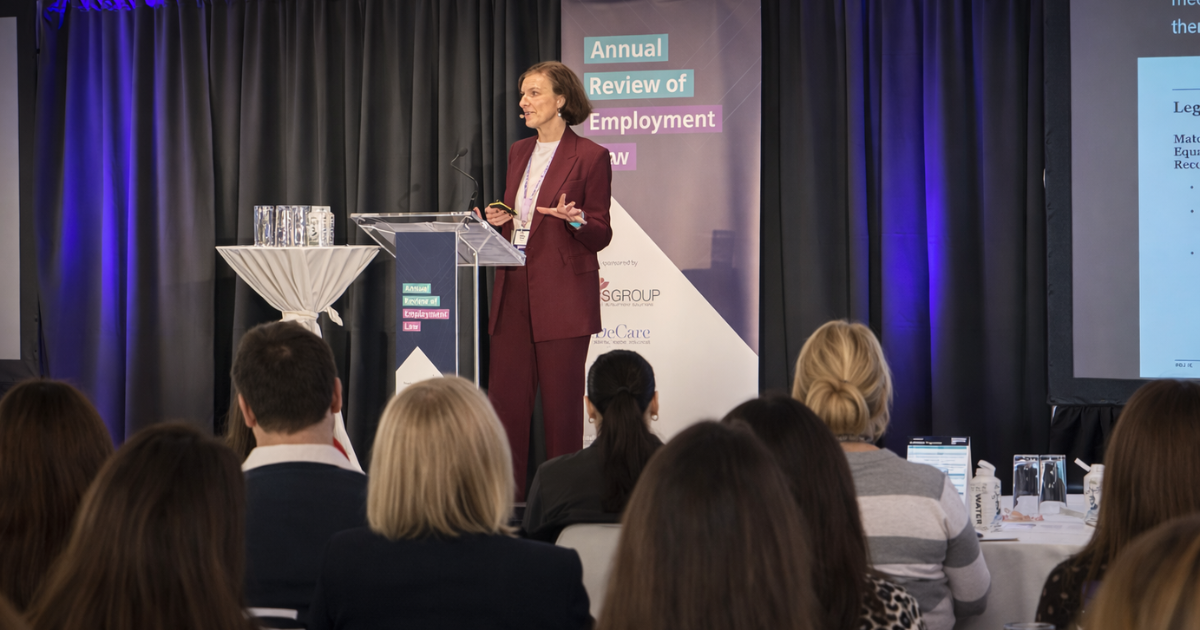

Christine, Julie, and Laura - known as the Knowledge Team - bring extensive expertise in employment law, HR, and learning & development. With diverse backgrounds spanning top-tier law firms, in-house roles, and voluntary organisations across the UK and Ireland, they provide informed and strategic support on employment matters.
Our team includes qualified (now non-practising) employment solicitors with experience in both legal and corporate sectors, alongside an experienced HR professional and CIPD Associate Member, ensuring a well-rounded approach to workplace challenges.

She's got the ring, we've got the rulings. Here's your Friday Round-Up of employment law - served fresh and swiftly. 💍
Top 5 reads for busy people:
- Beach Zoom is still a no - right to switch off is in full force 🏖️
- Missed notice on remote work ending now it is a compensation issue 💻
- Ford tried AI but ended up rehiring people 🤖
- Auto enrolment opt out window is open time to decide 💰
- I have received a request for an employment reference: How do I handle it?📄
And in other news... retirement ages has had a legal makeover. Make sure your policies get one too. Join our FREE webinar on 21 July and stay one step ahead. 🧓💼
CONTENTS ⚓︎
1. Case Law Reviews ⚓︎
Ciara Daly v DAA PLC Cork ADJ-00054765 conjoined with ADJ 54764, 54772 and 54776
Summary: A pay differential between employees performing like work was objectively justified by historical red circling and preserved contractual terms, so the equal pay claim failed.
Practical Guidance for Employers:
Employers should:
- Ensure that redeployment arrangements are recorded with precision. Where an employee is moved laterally, promoted, red-circled or transferred on protected terms, the letter should state clearly whether the move affects grade, pay scale, allowances, job title, progression and comparator status.
- Maintain a clear historical and evidential record explaining why pays vary. Red-circling may justify a pay differential, but only where it is genuinely unrelated to the protected ground and can be explained by objective factors such as historic contractual entitlement, collective agreement, restructuring, redeployment or market-rate transition. Employers should be able to produce job evaluations, pay bands, collective agreements, red-circling communications and comparator histories.
- Treat equal pay queries seriously. Defensive / dismissive responses may assist an inference of discrimination, even where the underlying explanation is ultimately lawful.
Stefan Puscasu v Rigotec International Limited ADJ-00053401
Summary: The employer's genuine redundancy defence failed because it could not demonstrate a fair and meaningful redundancy process, rendering the dismissal unfair.
Practical Guidance for Employers:
Employers should:
- Be able to prove both the commercial need and the fairness of the redundancy process. A downturn in work may justify redundancies, but assertions alone will rarely be enough. Employers should retain objective evidence such as client communications, order books, financial records, headcount data, forecasts and board or management minutes showing why redundancies were required.
- Warn employees that that their roles are at risk, given an opportunity to consult, advised of the selection criteria, allowed to comment on the proposed scoring, and considered for alternatives such as redeployment, reduced hours, lay-off or other suitable roles. If a matrix is used, the people who prepared and applied it should be available to explain it in evidence.
- Avoid treating immediate removal from site as a substitute for process. Security or client concerns may justify practical arrangements after a decision is made, but they do not excuse failure to consult or explain selection. A genuine downturn will not cure an opaque, collective, abrupt termination.
These case reviews were written by Patrick Barrett BL.
Patrick's legal education is robust, beginning with a BCL Law Degree from University College Cork (2012-2016), followed by an LL.M in Business Law from the same institution (2016-2017), and culminating in a Barrister-at-Law Degree from The Honorable Society of King’s Inns in Dublin (2019-2021). He has extensive experience on the South-West Circuit, handling Civil, Family, and Criminal Law cases, as well as advising the Citizen Advice Service. He has worked as an employment consultant, dealing with workplace investigations and bankruptcy procedures.
Remember: Our Irish case law reviews are now held in our case law section on our fully-searchable employment law hub website.
2. AI & Employment Law ⚓︎
64% of jobs will require significant reskilling due to AI – Ibec
Almost two-thirds of jobs will require significant reskilling because of the impact of artificial intelligence (AI), according to new research from business group Ibec. The report warns that Ireland will fail to fully realise its long-term AI economic potential without a deliberate shift in the national approach to lifelong learning. Read more.
AI in practice: Use cases in employment
Michael Egan, Senior Director in Arthur Cox's Legal Technology Group and Governance and Consulting Services Group, is joined by Louise O’Byrne, Partner in the Employment Group and Head of the Commercial Group, discuss how technology is shaping employment investigations and workplace relations. From scenarios such as data exfiltration to allegations of misconduct, the conversation explores the increasing complexity of modern investigations and the growing role of digital evidence across multiple platforms, as well as the evolving impact of AI tools in this space. Listen here.
Ford forced to rehire staff as AI fails to match their skills
Those who fear artificial intelligence may take over our jobs will feel relieved at news from Ford this week. The US carmaker has been forced to call veteran engineers out of retirement after AI failed to match their skills. Over the past few years, it has increasingly relied on AI across its engineering and manufacturing operations, including for quality checks. But it admitted to rehiring over 300 experienced engineers – nicknamed ‘grey beards’ – to help improve the reliability of its vehicles. More from Business Plus.
AI for HR Weekly Podcast with Barry Phillips 🎙️
Hub subscribers are beginning to request that our Chairman, Barry covers a particular AI topic in a future podcast. If you have a request, send it to him directly at barry@legal-island.com - he’ll feel like a DJ from the 80s…...🎧
You can tune into the latest episode right here - or, if you’re on the move, why not take us with you?
Listen on all major platforms: 🎧 Spotify or Apple Podcasts
Simply search for “AI for HR Weekly Podcast” and enjoy expert insights anytime, anywhere.
3. Retirement Age ⚓︎
Key Update on Retirement Age in Ireland
The Employment (Contractual Retirement Ages) Act 2025 (the “2025 Act”) introduces a new employment right for employees whose contract of employment contains a mandatory retirement age which is below the State pension age, currently set at 66. From the commencement date, employees will be entitled to notify their employer that they do not consent to retire at the contractual retirement age and wish to continue working. The WRC revised its Code of Practice on Longer Working (the “Code of Practice”) following the introduction of the 2025 Act. The Code of Practice comes into effect on the same day as the 2025 Act. Eversheds Sutherland outlines what employers need to do in this article.
Want more on this......
Read McCann Fitzgerald's article, Working Beyond Retirement: New Law Comes Into Effect here.
4. Workers' rights & public procurement contracts ⚓︎
Workers’ rights must be factored in when awarding public procurement contracts, say unions
Union members in the cleaning and security sectors are to protest this week in support of workers’ rights being included as a consideration in the awarding of public procurement contracts when new EU rules on the issue are published later this year. As Ireland takes over the EU presidency, rallies on the issue are due to take place in Dublin outside the Office of Government Procurement on Mayor Street and in Paris, France. Siptu is organising the Dublin event in conjunction with UNI Europa, the European federation of service sector trade unions. More from the Irish Times.
5. Right to disconnect ⚓︎
‘Don’t join Zoom from the beach’: Workers reminded of right to switch off on summer leave
Irish workers have been reminded of their legal right to disconnect from work while taking annual leave this summer by the Irish Congress of Trade Unions (Ictu). As summer holidays near, the unions have stated workers who are taking annual leave hold the right to “fully switch off from work, and a right not to be penalised for doing so”. The Workplace Relations Committee (WRC) acknowledged some elements of a right to disconnect in its code of practice in 2021. The Irish Times has more on this story.
Back to Top
6. Pay ⚓︎
Employee equity plans under the spotlight
Two recent decisions, one from the WRC and one from the Labour Court, have brought into sharp focus the question of whether forfeited restricted stock units (RSUs) and other equity-based awards should be considered part of ‘financial loss’ for the purposes of calculating compensation under the Unfair Dismissals Acts (UDA). The answer has significant implications for employers operating equity incentive plans. A&L Goodbody LLP has more on this.
Workers rally in Dublin on first day of EU Presidency
Workers in the cleaning, security and catering sectors held a rally in Dublin to demand better working conditions and wages to mark the first day of Ireland's EU Presidency. SIPTU and UNI Europa, the European federation of service sector trade unions, organised a demonstration outside the Office of Government Procurement on Mayor Street in Dublin. More from RTE.
No talks on public sector pay as deal expires
The latest public-sector pay deal has officially expired and formal talks have yet to begin on a successor agreement. The last deal ran from 1 January 2024 to 30 June 2026 and provided for pay increases of up to 10.25% over the course of the two-and-a-half-year period. More.
7. Data Protection ⚓︎
Data breaches going unreported, says Irish compliance survey
More than half (51pc) of surveyed compliance professionals in Ireland believe that data protection breaches go unreported within organisations, according to the results of a new survey by the Compliance Institute. Of this cohort, 19pc of respondents to the survey, which polled 150 compliance professionals working primarily in Irish financial services organisations, said that “many” breaches may go unreported, while 32pc believed that “a few” breaches may go unreported. Silicon Republic has more.
Data Protection Commission Publishes Annual Report for 2025 and Results of “Sharenting” Survey
Key points include:
- The DPC received 16,160 new cases from individuals in 2025, representing a 45% increase on 2024. 11,734 cases were concluded during the year, a 12% increase on 2024.
- The DPC concluded 208 valid cross-border complaints (as EU/EEA Lead Supervisory Authority). This represented a 43% increase on 2024.
- Total valid breach notifications received in 2025 was 6,521, representing a 16% decrease on 2024. 85% of these notifications were concluded by year end. Almost half of these breaches were a result of correspondence being sent to the wrong recipient.
You can download the report here.
Back to Top
8. Opt-out window opens for auto-enrolment pension scheme ⚓︎
Workers who have been automatically enrolled in the 'My Future Fund' pension scheme can choose to opt out of the system from 1st of July. More than 800,000 people, including 9,000 who voluntarily opted-in, have been enrolled in the scheme since the start of the year and have saved over €400 million. A two month opt-out window opens today and those who choose to leave the scheme will be automatically re enrolled after two years, if still eligible. RTÉ has more.
Back to Top
9. Just In Case You Missed It...... ⚓︎
The Employment Law Hub is a comprehensive, jurisdiction-specific resource designed for HR professionals, legal advisors, and business leaders. It centralises essential employment law and HR updates, expertly curated and written by leading HR and legal specialists to provide reliable, practical, and authoritative insights. We have over 700+ in depth articles and 1000+ case law reviews. As a subscriber, you have access to all of this. Check it out the full Hub here and below are some recent articles you may have missed.....
I have received a request for an employment reference: How do I handle it?
It is often a pre-condition of employment to provide one or more satisfactory references from previous employers and as such, where an employee is leaving employment, it is commonplace to request a reference from their employer. Prospective employers may also reach out to ask for a reference in respect of a former employee. There are a number of factors an employer must consider when they receive such a request. Leah Moriarty, Solicitor, RDJ LLP explores this topic in this month's "How do I handle it?".
AG ADVISES - EU Pay Transparency Directive – where are we now and what should employers be doing?
The 7 June 2026 deadline for full transposition of EU Directive 2023/970 into Irish law has been and gone and the Minister for Children, Disability and Equality (Minister) has now confirmed that Ireland will implement the Directive on a phased approach. Due to Ireland’s delay in implementation the Minister also confirmed that employers will not be penalised for failing to comply with the requirements of the Directive that have not yet been introduced into Irish law. In this article Kate Field of AG responds to frequently asked questions raised recently by clients in preparation for the 7 June deadline.
10. Employment News in the Media
The mother of a teenage sex assault victim has won €2,500 in an employment rights case, after her boss revoked a part-time remote work deal set up to help her look after her daughter and ordered her back to work with one day's notice. The award was made to the administrative worker in a wholly-anonymised decision under the Work Life Balance and Miscellaneous Provisions Act 2023 published by the WRC. It is the first time a worker has won compensation for not getting four weeks' notice, in writing, for the termination of a remote work arrangement, and is the maximum award permitted by the act. RTÉ has more on this.
SIPTU reports they received confirmation from management in Castolin Eutectic Ireland, Citywest, Dublin 24, that the company will implement a Labour Court Recommendation on redundancy terms, bringing to a successful conclusion a campaign of industrial action by our members. The Labour Court Recommendation provides for an increase in redundancy terms of 1.5 weeks per year of service over statutory entitlements. SIPTU members at Castolin had taken industrial action and placed pickets on the facility for three days over the past week and had served notice for a further five days of stoppages next week. Following confirmation by management that the terms of the recommendation will be implemented, this further action will not take place.
The Irish Times reports professional services firm Cognizant cut close to 200 jobs in Ireland a year after it announced plans to add more than 300 staff. The company, which has bases in Dublin and Cork, provides staff for tech and life sciences companies in Ireland that require specialist employees on a project-by-project basis. New accounts for its main Irish entity show it reduced its Irish headcount from 1,460 to 1,263 employees the year after it announced the hiring plans. More here.
An accountancy firm has said a veteran bookkeeper it was meant to keep on when it bought out her employer of 45 years was “forgotten” in an “administrative error” during the takeover. The bookkeeper, Siobhan Fanning, along with receptionist Sandra Breen, both allege they suffered ageist discrimination, unfair dismissal and other employment rights breaches when MG Business Advisory Services Ltd merged with another Drogheda accountancy practice, Callan Stringer & Co, last year. The women, who are aged in their 60s and worked together for four and a half decades, say they were excluded from the business transfer – while a younger colleague was reassured about her future in the merged business and kept on. More from the Irish Times.
Back to Top
11. Free Webinars This Month
New Rules on Retirement Age – What Employers Need to Know
📅 Tuesday 21 July 2026
🕒 11.00 am to 11.45 am
📍 Live online | Free to attend
Register HERE.
Ireland's approach to contractual retirement ages changed significantly on 29 June 2026 with the commencement of the Employment (Contractual Retirement Ages) Act 2025 and the updated Code of Practice on Longer Working.
These changes introduce a new consent-based framework that will affect how employers manage retirement, employee requests to work beyond retirement age, and the drafting of contracts and workplace policies.
Laura McKee, Legal Island will be joined by Anne O'Connell, Anne O'Connell Solicitors, where she will explain what the new framework means in practice and the steps employers should be taking now.
This webinar will explore:
1. How the new legislation interacts with existing equality law
2. Practical changes employers should make to contracts, policies and retirement procedures
3. Managing requests to continue working beyond retirement age while minimising legal risk
4. Common pitfalls and practical tips for HR professionals and managers.
Enjoy the weekend!
Legal Island
Continue reading
We help hundreds of people like you understand how the latest changes in employment law impact your business.
Please log in to view the full article.
What you'll get:
- Help understand the ramifications of each important case from NI, GB and Europe
- Ensure your organisation's policies and procedures are fully compliant with NI law
- 24/7 access to all the content in the Legal Island Vault for research case law and HR issues
- Receive free preliminary advice on workplace issues from the employment team
Already a subscriber? Log in now or start a free trial