

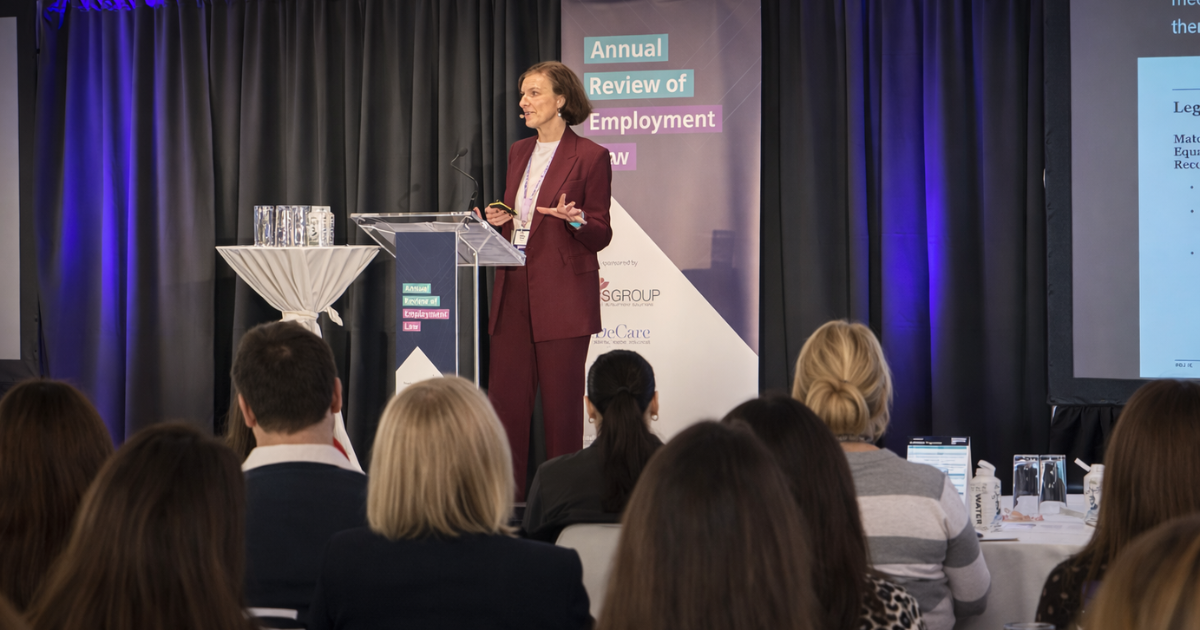
Caroline Reidy is Head of HR Solutions at NFP and a HR and Employment Law Specialist. Caroline sold her company, The HR Suite, in 2025 to NFP, an AON Company, and as of 17th November 2025 The HR Suite officially rebranded to NFP.
Caroline is a former member of the Low Pay Commission and is also an adjudicator in the Workplace Relations Commission. Caroline is also an independent expert observer appointed by the European Parliament to the Board of Eurofound. Caroline is also on the Board of the Design and Craft Council Ireland and is a Governor on the Board of Munster Technology University.
She has also completed a Master's in Human Resources at the University of Limerick, and she is CIPD accredited as well as being a trained mediator. Caroline completed her diploma in Company direction from the IOD with a Distinction and completed her assessment to become a Chartered Director of the IOD. Caroline had worked across various areas of HR for over 25 years in Kerry Group and in the retail and hospitality sector, where she was the Operations and HR Director of the Garvey Group prior to setting up The HR Suite in 2009.
She has also written 2 books, has done a TEDx and is a regular conference speaker and contributor to national media and is recognised as a thought leader in the area of HR and employment law. Caroline also mentored female entrepreneurs on the Acorns Programme. Originally from Ballyheigue, Co. Kerry, now living in Dublin, is very proud of her Kerry roots.

The EU Platform Work Directive (Directive (EU) 2024/2831) was adopted in October 2024 and must be transposed into Irish law by 2 December 2026. For HR, it prompts a review of where digital rules shape work, because they can trigger employment, pay, equality, and data/AI obligations.
If an organisation uses an app or digital tool to allocate shifts, score performance, or restrict access to work, the Directive deserves attention - even if the business would not describe itself as a platform.
In simple terms, it links three topics HR already manages: employment status, working conditions, and data/AI governance. It targets misclassification and algorithmic management - automated systems that allocate tasks, monitor performance, influence pay, or limit access to work.
Employment status disputes turn on how the relationship works in practice, not labels. EU law focuses on whether services are provided for and under the direction of another for remuneration. In platform models, authorities look for control indicators such as price-setting, ratings, limits on accepting work, and deactivation. In Ireland, Revenue Commissioners v Karshan (Midlands) Ltd t/a Domino’s Pizza [2023] IESC 24 reinforced a fact-based test centred on personal service and control. Genuine autonomy supports self-employment.
Irish implementing legislation is still to be finalised, but the Directive is broad. It can apply where individuals are labelled contractors, where intermediaries sit between platform and worker, and to platforms based outside the EU if work is carried out in the EU. It also sits alongside the GDPR and the EU AI Act.
What counts as “platform work”?
“Platform work” is work organised through a digital labour platform, usually an app or website, where tasks are performed for payment and technology is used to organise, monitor, or make decisions affecting the work. It can cover work carried out in person or online.
In Ireland, this could include outsourced delivery, on-demand services, or internal scheduling tools where an algorithm decides who gets the next shift.
The definition is deliberately broad. Even if you do not see your organisation as a platform, you may buy platform services or use internal systems that allocate work and track performance. Map where digital tools influence allocation, availability, ratings, pay, or restriction of access to work, and identify whether those decisions are controlled by the employer, the platform operator, or both.
The compliance picture differs across three models. A business that operates the platform is most likely to fall directly within the Directive’s core obligations. An employer using platform-style tools for only part of its activities may be in scope for that part of the business. Where an employer uses a third-party platform, the provider may carry the main obligations, but the employer can still face employment-law, equality, and data-protection risk if it relies on platform outputs to allocate work, set pay, or restrict access to work.
Algorithmic management: what transparency and oversight will look like
The day-to-day impact is greater accountability for automated tools. Where systems allocate work, monitor performance, restrict access to work, or influence pay, the employer, the platform operator, or both - depending on who operates the system and relies on its outputs—must give clear information to workers and, where relevant, worker representatives. If a third-party provider is involved, contracts should make the split of responsibility clear.
Meaningful human oversight is required for significant decisions, with a route to challenge outcomes. If income or access to work can drop because of a rating or automated rule, there should be an explanation and human review. This aligns with the GDPR approach to solely automated decisions and with oversight duties under the EU AI Act for certain high-risk employment systems.
Review what data is collected, who can access it, how long it is kept, and how outputs affect allocation, ratings, pay, and deactivation. Keep the process simple: explanations, human review, and an appeals route.
Employment status: where the burden of proof may shift
The Directive introduces a rebuttable presumption of employment where facts point to direction and control. If a worker claims employee status, the employer, the platform operator, or both may have to show genuine self-employment, depending on who controls the working arrangements. In Ireland, reclassification can trigger obligations across working time, terms information, pay, equality, and tax/PRSI.
Practical steps HR and business leaders can take now
With transposition due by December 2026, act now:
- Map your exposure: where do you run or buy platform services, and where do internal tools affect pay?
- Reality-check status: test control, dependency, personal service, and whether substitution is real.
- Plan “if employee” compliance: prepare for working time, pay, terms, and equality impacts.
- Audit algorithmic management: document tools for allocation and access, explain key logic, and build review and appeal.
- Align with GDPR and AI governance: review data minimisation, retention, access controls, DPIAs, and whether employment AI is high risk.
Conclusion
The Platform Work Directive is not limited to gig-economy brands. Any model where digital systems influence allocation, monitoring, pay, or access to work should be reviewed against this framework.
For HR in Ireland, the priority is to map platform-style arrangements, test classification risk, and strengthen governance for automated decisions before Irish measures are introduced.
This article was written by Caroline Reidy, Head of NFP HR Solutions Ireland Limited, HR and Employment Law Specialist
For more information on the NFP HR Solutions Ireland Limited:
Telephone: (066)7102887 (Head Office)
Email: hrsolutions@nfpireland.ie
Visit: https://nfpireland.ie
Continue reading
We help hundreds of people like you understand how the latest changes in employment law impact your business.
Please log in to view the full article.
What you'll get:
- Help understand the ramifications of each important case from NI, GB and Europe
- Ensure your organisation's policies and procedures are fully compliant with NI law
- 24/7 access to all the content in the Legal Island Vault for research case law and HR issues
- Receive free preliminary advice on workplace issues from the employment team
Already a subscriber? Log in now or start a free trial
FREE WEBINAR: Employee Data - What ROI & NI Employers Must Collect, Keep, and Delete